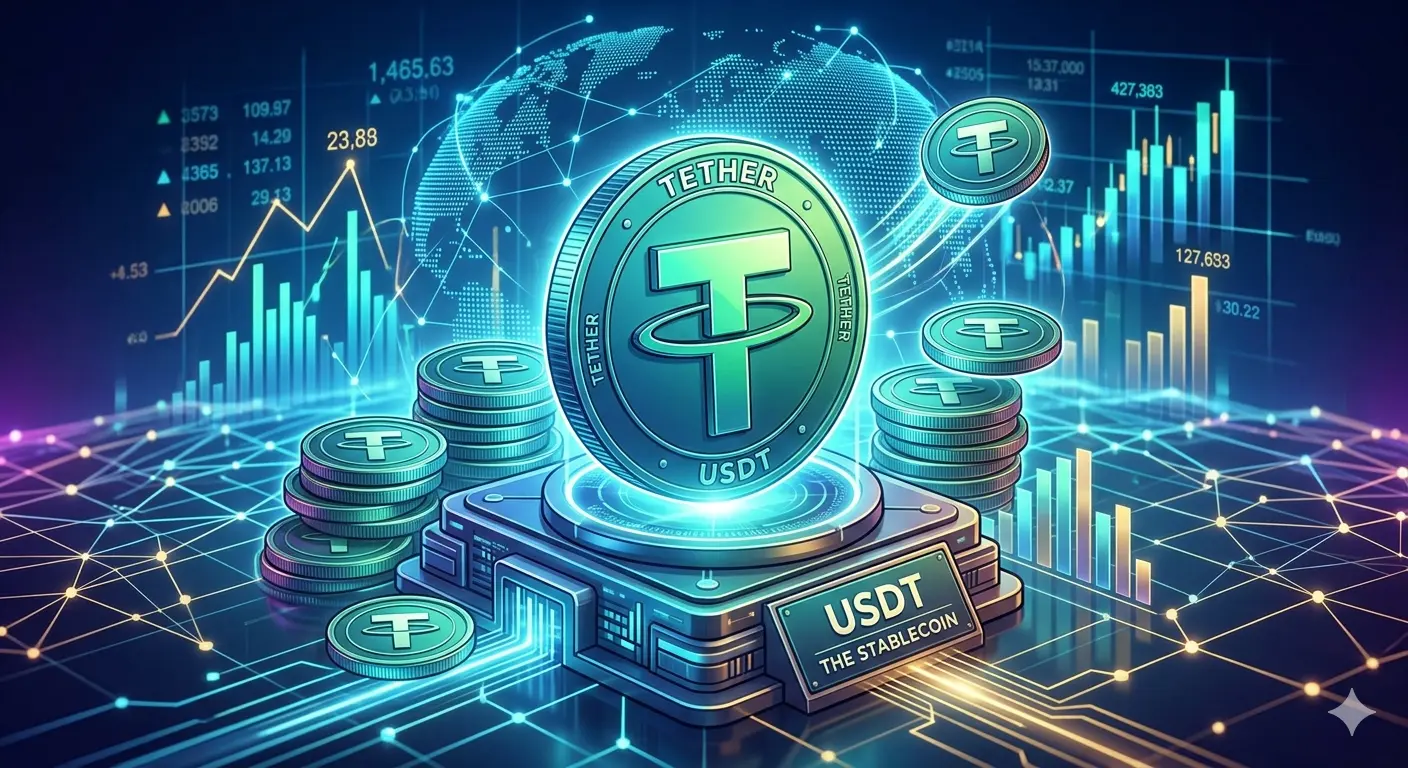
Tether (USDT): The Digital Dollar That Powers Cryptocurrency Markets
Introduction
Imagine a cryptocurrency that doesn’t go up or down in value. No wild 50% swings, no “to the moon” volatility, no sleepless nights watching charts. That’s Tether (USDT) – a digital dollar designed to always be worth exactly one US dollar. In a crypto world famous for extreme price fluctuations, Tether serves as the calm harbor where traders can park their money when the seas get rough.
But USDT is far more than just a stable place to hide from volatility. Today, it has become the lifeblood of the entire cryptocurrency ecosystem – the most traded digital asset on the planet, surpassing even Bitcoin in daily trading volume. With over 500 million users worldwide and a market capitalization exceeding $180 billion, Tether has evolved from a simple idea into what many call the “digital central bank” of crypto. This article explores where USDT came from, how it works, why it matters, and the controversies that continue to surround it.
The Birth of Tether: Solving Crypto’s Volatility Problem
The Problem: A Currency Too Unstable to Use
In the early days of cryptocurrency, a fundamental problem became painfully clear: if Bitcoin’s value could drop 30% in a single day, how could anyone use it as a practical currency? Businesses couldn’t price goods in Bitcoin when its purchasing power changed so dramatically. Traders couldn’t safely hold profits between trades without risking massive losses. And everyday users couldn’t rely on crypto for payments when a coffee bought with Bitcoin might cost twice as much by the time it was poured.
What the crypto world desperately needed was a digital asset that combined the speed and efficiency of blockchain technology with the stability of traditional fiat currency. This problem set the stage for Tether’s creation.
The Founders and the Realcoin Beginning
The story of Tether begins not in 2014, but slightly earlier. In 2012, programmer J.R. Willett proposed a revolutionary concept: building new cryptocurrencies on top of Bitcoin’s existing blockchain. This idea led to the creation of Mastercoin (later renamed the Omni Layer Protocol), which provided the technical foundation for what would become Tether.
Key figures in this early work included Brock Pierce, then chairman of the Bitcoin Foundation, and programmer Craig Sellars, who served as Chief Technology Officer. In July 2014, Pierce, Sellars, and advertising entrepreneur Reeve Collins launched a startup called Realcoin, headquartered in Santa Monica, California.
On October 6, 2014, using Bitcoin’s blockchain and the Omni Layer protocol, the company issued its first tokens. The founders made a bold promise: “Realcoin will be fully transparent, reliable, secure and insured. Every dollar in our reserve will be represented by one coin in circulation with the possibility of redemption at any time”.
The Rebranding to Tether
Just over a month later, on November 20, 2014, the project underwent a crucial rebranding. Realcoin CEO Reeve Collins announced the new name: Tether. The reasoning was strategic – they wanted to distance themselves from the volatile “altcoin” label. As the company explained: “We are not an altcoin, we do not represent a separate blockchain. We are a service, a token representing dollars. Tether is a digital link to a real-world asset”.
Soon after, Tether Limited, registered in Hong Kong and the Isle of Man, announced a closed beta for three tokens: USTether (US+) for the US dollar, EuroTether (EU+) for the euro, and YenTether (JP+) for the Japanese yen. In January 2015, the Hong Kong cryptocurrency exchange Bitfinex listed Tether, marking the beginning of USDT’s journey to becoming the dominant stablecoin.
How Tether Works: The Mechanics of a Digital Dollar
The Basic Model: One-to-One Backing
At its simplest level, Tether operates on a straightforward principle: for every USDT token in circulation, Tether Limited claims to hold one US dollar (or equivalent assets) in reserve. This one-to-one backing is what maintains the peg – the stable $1 value that makes USDT useful.
The circulation cycle works like this:
1. A user deposits fiat currency (traditional money) into Tether’s bank account
2. Tether creates (mints) an equivalent number of USDT tokens and sends them to the user
3. The user can then trade, transfer, or hold these tokens anywhere in the crypto ecosystem
4. When the user wants their dollars back, they return the USDT tokens to Tether
5. Tether destroys (burns) the tokens and sends fiat currency back to the user
This creation and destruction mechanism, combined with market arbitrage, keeps USDT’s price stable. If USDT ever trades below $1, traders can buy it at a discount and redeem it for $1, pocketing the difference and pushing the price back up. If it trades above $1, traders can mint new USDT by depositing dollars, increasing supply and bringing the price back down.
From One Blockchain to Many
Originally, USDT was only available on Bitcoin’s blockchain through the Omni Layer protocol. However, as the crypto ecosystem evolved and transaction fees on Bitcoin rose, Tether expanded to other networks.
Today, USDT is issued on multiple blockchains including Ethereum, Tron, Solana, Avalanche, Polygon, Tezos, Algorand, EOS, Celo, and the Liquid Network. Each version of USDT is essentially the same token but operates on different networks, each with its own advantages.
The Tron network (TRC-20) has become particularly popular for USDT transactions due to its extremely low fees and fast processing times. As of recent data, over 75 billion USDT has been minted on Tron, surpassing Ethereum in total USDT supply. Ethereum remains important for decentralized finance (DeFi) applications, but for everyday transfers and payments, Tron is often the network of choice.
What Actually Backs USDT?
This is perhaps the most controversial and important question about Tether. The company has significantly changed its reserve composition over time in response to criticism and regulatory pressure.
In the early days, Tether claimed that each USDT was backed 1:1 by actual US dollars in bank accounts. However, investigations later revealed that this wasn’t always true. In 2021, as part of a settlement with the New York Attorney General, Tether admitted that for a period of time, it did not have sufficient reserves to back all USDT in circulation and had even used $900 million of reserves to cover losses at the affiliated Bitfinex exchange.
Since then, Tether has transformed its reserve composition. In early 2021, commercial paper (short-term corporate debt) made up about 65% of Tether’s reserves. By the end of 2022, Tether had completely eliminated commercial paper from its backing, replacing it with US Treasury bills.
As of March 2024, Tether’s reserve structure consists primarily of:
US Treasury bills and government bonds (about 80% of reserves)
Cash and cash equivalents in short-term bank deposits
Corporate bonds, precious metals, and Bitcoin
Secured loans to third-party companies
This shift toward US government debt has made Tether’s reserves more transparent and arguably more secure. In fact, Tether has become one of the top 20 holders of US Treasury bills globally, giving it surprising influence in traditional financial markets.
Why USDT Matters: Real-World Use Cases
The Trader’s Best Friend
For cryptocurrency traders, USDT is indispensable. When volatility spikes and prices start crashing, traders can instantly convert their volatile assets into USDT, preserving their capital without leaving the crypto ecosystem. This “safe harbor” function is critical – moving money to a traditional bank account would take days and incur fees, while converting to USDT happens in seconds.
Moreover, USDT serves as the primary trading pair on virtually every major cryptocurrency exchange. Whether someone wants to buy Bitcoin, Ethereum, or any obscure altcoin, they’ll almost always find a USDT trading pair. This deep liquidity makes USDT the backbone of crypto trading, reducing slippage and enabling efficient price discovery.
A Lifeline in Unstable Economies
Perhaps the most profound impact of USDT has been in countries suffering from hyperinflation and economic instability. In nations like Turkey, Argentina, Venezuela, and Nigeria, local currencies can lose value rapidly, wiping out people’s savings.
For millions of people in these countries, USDT has become a lifeline – a way to preserve wealth without relying on unstable local banks or facing capital controls. Individuals can hold their savings in USDT, knowing that its value won’t evaporate overnight. Businesses can price goods and services in USDT, avoiding the chaos of constantly adjusting prices for inflation.
Migrant workers send money home using USDT, bypassing expensive wire transfer services and slow bank processing. A worker in Europe can send USDT to family in the Philippines in minutes for a fraction of a cent in fees, compared to days and high costs through traditional remittance channels.
The Engine of Decentralized Finance (DeFi)
In the world of decentralized finance, USDT plays a foundational role. DeFi protocols allow users to lend, borrow, and earn interest on their crypto assets without traditional banks. USDT is one of the most widely used assets in these protocols.
Users can deposit their USDT into lending platforms like Aave or Compound and earn interest paid by borrowers. They can provide liquidity to decentralized exchanges like Uniswap, earning trading fees from users who swap tokens. They can participate in yield farming strategies that generate returns by moving USDT between different DeFi applications.
Because USDT maintains a stable value, these DeFi activities offer predictable returns without the risk of the underlying asset losing value. This stability has made USDT the preferred stablecoin for many DeFi users, despite competition from other options like USDC and DAI.
Cross-Border Payments and Business Transactions
Traditional international wire transfers are slow (taking 3-5 days), expensive (costing $30-50 per transfer), and require extensive paperwork. USDT transfers, by contrast, settle in seconds or minutes and cost pennies.
This efficiency has made USDT attractive for businesses operating internationally. Companies can pay overseas contractors, settle invoices with international suppliers, and move money between global offices using USDT. The funds arrive quickly, the costs are predictable, and there’s no need to maintain multiple currency bank accounts around the world.
The Controversies: Tether’s Dark Side
The Transparency Problem
For years, Tether operated with minimal transparency. The company refused to conduct full independent audits, instead providing only “attestations” – snapshots of reserves at specific moments that didn’t follow full auditing standards.
Critics argued that these attestations were insufficient to prove that Tether actually held the assets it claimed. The lack of transparency fueled endless speculation and conspiracy theories. Was Tether secretly creating unbacked USDT to prop up Bitcoin prices? Were its reserves actually composed of risky or illiquid assets? Without a real audit, no one could know for certain.
This changed dramatically in March 2026, when Tether announced it had hired KPMG, one of the “Big Four” global accounting firms, to conduct its first-ever full financial audit of approximately $185 billion in USDT reserves. The company also engaged PwC, another Big Four firm, to help improve its internal systems and controls.
Tether CEO Paolo Ardoino stated: “Trust is built when institutions are willing to fully embrace scrutiny. This audit reflects years of internal preparation to bring Tether up to Big Four standards”. This move represents a major shift toward transparency and could significantly improve Tether’s credibility.
Regulatory Run-Ins and Penalties
Tether has faced significant regulatory actions, most notably in 2021. In February of that year, the New York Attorney General’s office concluded an investigation revealing that Tether had misrepresented its reserves. The company settled for $18.5 million and agreed to submit quarterly reports on its reserve composition.
Later that year, in October, the US Commodity Futures Trading Commission (CFTC) fined Tether $41 million for misleading investors about whether USDT was fully backed by US dollars. The CFTC found that Tether had only enough reserves to back about 27.6% of its outstanding USDT during certain periods from 2016 to 2019.
These penalties, totaling nearly $60 million, served as a wake-up call. Tether began its long journey toward greater transparency and regulatory compliance, culminating in the 2026 KPMG audit announcement.
The Recent Loan Controversy
As recently as March 2026, new questions emerged about Tether’s financial relationships. Reports revealed that Tether had made an undisclosed loan to the Lutnick family, which controls Cantor Fitzgerald – the Wall Street firm that serves as Tether’s reserve custodian.
This loan created a potential conflict of interest, as Tether’s reserves are supposed to be independently managed. The revelation raised concerns about whether Tether’s custodial arrangements are truly arms-length transactions or whether they involve hidden financial entanglements.
Critics warned that such conflicts could undermine confidence in USDT and attract further regulatory scrutiny. The incident highlights that despite progress on transparency, questions about Tether’s operations continue to surface.
Tether’s Market Dominance: By the Numbers
The scale of Tether’s success is difficult to overstate. As of early 2026, USDT’s market capitalization exceeds $184 billion, making it not just the largest stablecoin but one of the largest cryptocurrencies overall. This represents a commanding lead over its nearest competitor, USDC, which has a market cap of approximately $78 billion.
USDT commands more than 58% of the entire stablecoin market, and its dominance continues to grow. The token has reached over 500 million users worldwide – representing about 6.25% of the global population. In terms of trading volume, USDT regularly surpasses Bitcoin, making it the most actively traded cryptocurrency on most exchanges.
This dominance creates a powerful network effect. More users mean more liquidity, which attracts more users, which further deepens liquidity. For any new stablecoin to challenge USDT, it would need to overcome this massive head start and convince exchanges, DeFi protocols, and millions of users to switch.
The Competition: USDC, DAI, and Others
Despite Tether’s dominance, it faces competition from other stablecoins, each with different strengths.
USDC (issued by Circle) has long positioned itself as the “compliant” alternative to Tether. USDC undergoes regular audits by Deloitte, one of the Big Four accounting firms, and Circle is a regulated financial institution in the United States. This compliance focus has made USDC popular among institutional investors and regulated entities. However, Tether’s move to hire KPMG for a full audit threatens to erode USDC’s key differentiator.
DAI takes a completely different approach. Instead of being backed by dollars in a bank account, DAI is a decentralized stablecoin backed by cryptocurrency collateral (primarily Ethereum) locked in smart contracts. While DAI offers greater decentralization and transparency, it has proven vulnerable to extreme market volatility – during the March 2020 crash, DAI lost its peg and required emergency intervention.
Other competitors include BUSD (Binance USD, now being phased out), USDD, and various algorithmic stablecoins (the spectacular collapse of TerraUSD in May 2022 demonstrated the dangers of algorithmic designs).
The Future of Tether
The GENIUS Act and US Regulation
The regulatory landscape for stablecoins is rapidly evolving. In the United States, the GENIUS Act (officially the “Guiding National Innovation for US Stablecoins” Act) has established a federal regulatory framework for stablecoin issuers. The law requires 100% reserve backing, annual independent audits, anti-money laundering compliance, and tiered regulatory requirements based on issuer size.
To comply with this new environment, Tether has launched USAT – a separate, fully US-regulated stablecoin designed specifically for the American market. USAT is issued by Anchorage Digital, the first federally chartered crypto bank in the US, and has already passed an audit by Deloitte. This dual-track approach allows Tether to continue serving global markets with USDT while offering a fully compliant option for US customers.
Expansion Beyond Stablecoins
Tether is no longer just a stablecoin company. The organization has diversified into multiple industries and products:
Tether Gold (XAUT) – A digital token backed by physical gold held in Swiss vaults, offering investors exposure to gold without storage complications.
Bitcoin Mining – Tether has invested $500 million in building mining farms across Uruguay, Paraguay, and El Salvador, with each facility having 40-70 megawatts of capacity.
Venture Investments – The company has backed Northern Data, a German Bitcoin mining firm, with a €575 million credit line, and participated in the $1 billion Volcano Energy Bitcoin mining project in El Salvador.
Telecom and AI Ventures – CEO Paolo Ardoino has announced plans to roll out five new projects in 2024 aimed at “destroying popular centralized Web2 services,” signaling ambitions far beyond cryptocurrency.
The Unresolved Questions
Despite Tether’s progress, significant questions remain. Will KPMG’s audit be truly independent, or will it find issues that Tether has managed to hide for years? Can Tether maintain its peg during a true “bank run” scenario where hundreds of billions in USDT are redeemed simultaneously? How will global regulators, particularly in Europe with its MiCA framework, treat Tether going forward?
Most fundamentally, can a private company really be trusted as the issuer of the world’s most widely used digital dollar? Or is Tether a temporary solution until central banks launch their own digital currencies (CBDCs)?
Conclusion
Tether (USDT) represents one of the most consequential innovations in the history of cryptocurrency – and one of the most controversial. From its origins as Realcoin in 2014 to its current status as a $184 billion financial behemoth, Tether has fundamentally changed how crypto markets operate.
For traders, USDT provides essential stability and liquidity. For people in unstable economies, it offers a lifeline to preserve wealth and send payments. For the DeFi ecosystem, it serves as foundational infrastructure. USDT has become so deeply embedded in crypto markets that it’s difficult to imagine how they would function without it.
Yet Tether’s journey has been marked by controversy, regulatory penalties, and persistent questions about transparency. The company has made significant strides – eliminating commercial paper from its reserves, moving toward full Big Four audits, and launching regulated products for the US market. But trust, once broken, is difficult to fully restore.
As USDT approaches a decade of existence, it stands at a crossroads. Will it complete its transformation from a controversial, opaque operation into a transparent, regulated financial institution? Or will new scandals and regulatory actions undermine its dominance?
For the millions of users who rely on USDT daily – and for the cryptocurrency industry that depends on its liquidity – the answers to these questions matter enormously. Tether is not just another cryptocurrency. It has become the digital dollar that powers the crypto economy, for better or worse. And its future will shape the future of digital finance itself.
Official Website: tether.to (official site with transparency reports and latest news)
Market Data: CoinGecko (price, market cap, trading volume), CoinMarketCap
Explorers: Etherscan (ERC-20), Tronscan (TRC-20), Solana Explorer
News: Bitcoin.com News, Cointelegraph