What is Romance Scam?
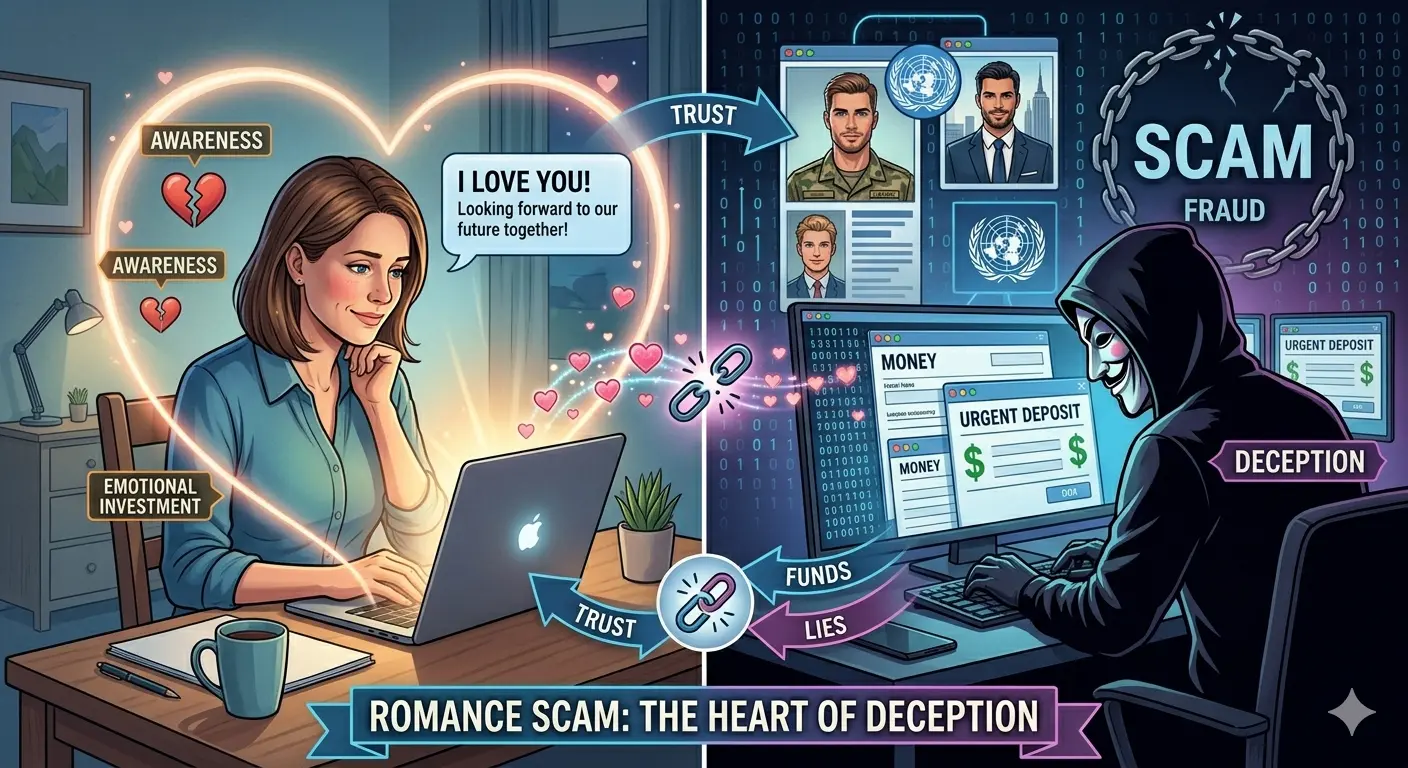
A romance scam is a confidence fraud where criminals create fake online identities to manipulate victims into a false relationship. They exploit emotional connections to steal money, personal data, or gifts, often claiming crises, travel plans, or investment opportunities to justify their requests.
Scope of Romance Scam
The scope of romance scams is vast and escalating globally. It spans all demographics, affecting millions across continents. Financially, losses exceed billions annually—U.S. victims alone reported $1.5 billion in 2024. The scope includes organized crime networks, particularly in West Africa and Southeast Asia, utilizing sophisticated tactics like AI-generated identities making it a pervasive Global Threat.
The scope of romance scams in India is also substantial and escalating rapidly:
Financial losses: Victims lose huge amounts, with recent cases reporting ₹49 lakh in Lucknow, ₹66.4 lakh in Noida, and ₹2.58 crore in Hyderabad.
Victim demographics: 1 in 7 Indians has lost money, averaging ₹2.8 lakh per victim. Young adults (25-34) are most frequently targeted.
Widespread exposure: 60% of Indians have received fake dating app invitations, and 75% have encountered AI-generated fake profiles.
Common platforms: Scammers operate on dating apps, matrimonial sites like Shaadi.com, and social media.
The United States reports the highest cases, accounting for 38% of new romance scam profiles globally, followed by Nigeria (14%) and India (12%) .
Understanding the Criminal Profile
Organized Crime
Romance scam is organized crime because it operates through sophisticated transnational networks. Criminal hubs in West Africa (e.g., Nigeria, Ghana) and Southeast Asia (e.g., Cambodia, Myanmar) run large-scale operations using fake identities, money mules, and human trafficking. These syndicates industrialize fraud, laundering billions annually through crypto and shell companies.
Key Traits of Scamers
Patience
Romance scammers exhibit extreme patience, often spending weeks or months building trust. They communicate daily, feign deep emotional connection, and slowly groom victims before introducing financial requests—manipulating slowly to lower defenses and maximize eventual exploitation.
Emotional Intelligence
Romance scammers possess high emotional intelligence. They expertly read victims’ vulnerabilities—loneliness, grief, or desire—and mirror empathy, affection, and shared values. This emotional manipulation builds deep trust, allowing scammers to exploit feelings and bypass rational judgment effectively.
Isolation Tactic
Scammers isolate victims by discouraging outside opinions. They claim friends and family “don’t understand” the relationship, create secrecy, and demand exclusive communication. This cuts victims off from support systems, making them more dependent and vulnerable to manipulation.
The Lifecycle of a Scam (Chronology)
The Approach (Platform Selection)
Platforms Used
Romance scams occur on dating apps (Tinder, Bumble), social media (Facebook, Instagram), messaging apps (WhatsApp, Telegram), professional networks (LinkedIn), and even gaming platforms & Quora like apps. Scammers exploit any space where personal connections form.
Scammers initiate contact through wrong number texts, fake dating profiles, or social media friend requests. They use stolen photos, craft compelling bios, and engage victims with flattering messages, manufactured coincidences, or fabricated emergencies to establish trust quickly before escalating the manipulation.
Example: A scammer uses a stolen photo of a military officer or a successful surgeon and sends a “wrong number” text to initiate contact.
The Grooming Phase (Building the Fantasy)
Love Bombing
Love bombing in romance scams involves overwhelming victims with excessive affection, compliments, and grand romantic gestures early in the relationship. Scammers shower targets with daily “good morning” texts, poetic declarations, promises of a future together, and rapid declarations of love—often within days. This intense emotional flooding lowers defenses, creates dependency, and accelerates trust. Victims feel uniquely cherished, making them more susceptible to later manipulation and financial requests disguised as acts of devotion.
The Excuse
Providing a reason why they cannot meet in person.
Example: I am a U.S. doctor working for the UN in Syria. I am coming to India to marry you next month, but my phone is restricted.
The Crisis(The Ask)
The Hook: A fabricated emergency appears that only the victim can solve.
Common Scenarios:
Medical Emergency: “My daughter was in a car accident; I need money for surgery immediately.”
Travel Issues: “I was detained at the airport in Dubai; I need customs fees to release my gold.”
Investment Tip: “I have insider trading knowledge. If you invest $5,000 in this crypto app, you will make $50,000 overnight.
The Escalation(The Bleed)
Increasing Pressure: Once the first payment is made, the demands become larger and more frequent.
Guilt Trips: Using emotional manipulation to make the victim feel responsible for the scammer’s well-being.
Example: “If you don’t send the money for my operation, I will die, and it will be your fault.”
The End (The "Ghost")
The Disappearance: When the victim is financially drained or realizes the fraud, the scammer deletes all profiles and cuts contact.
The Double Tap: Scammers often sell the victim’s information to other criminals, leading to “recovery scams” where a fake agency promises to get the money back for a fee.
Real Life Stories of Romance Scam
Fake Jason Momoa
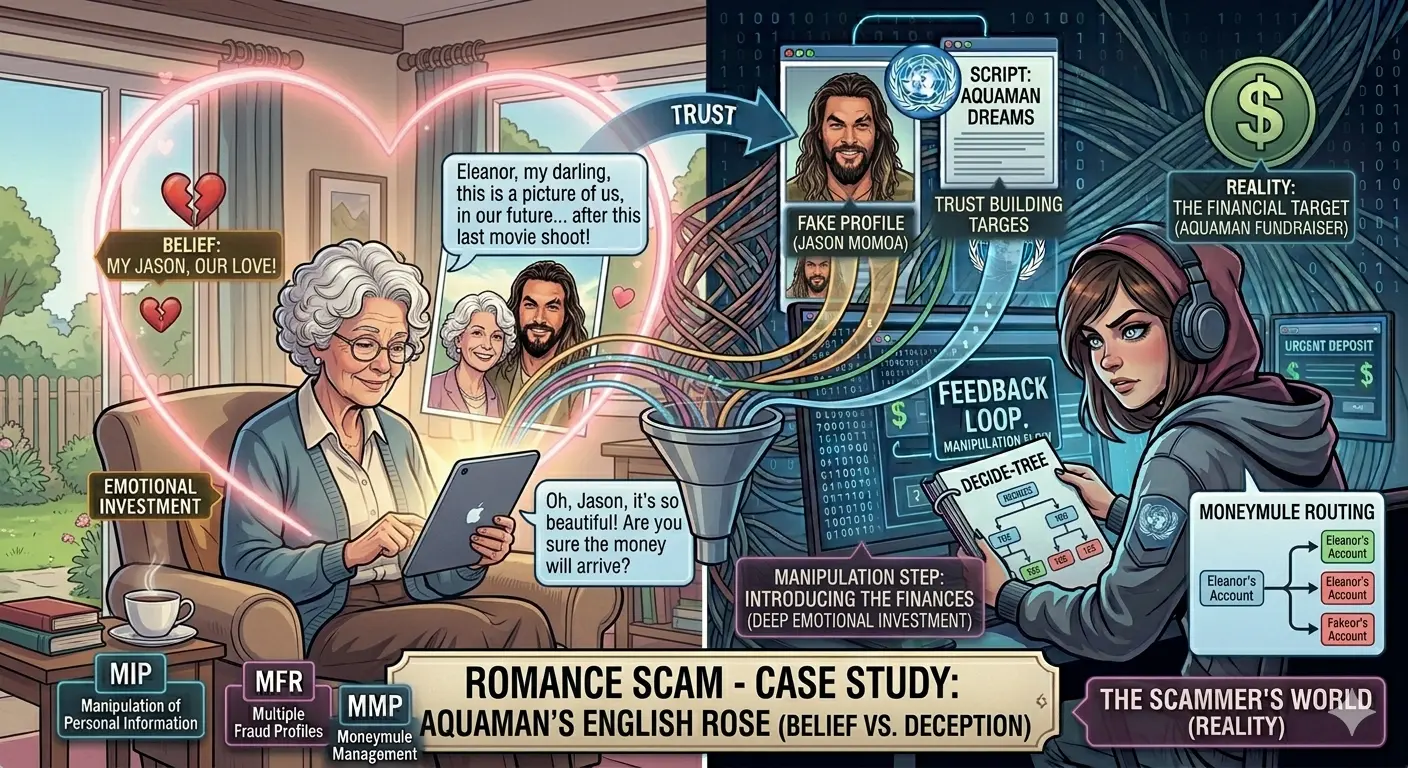
The Widow Who Lost Everything to a Fake Jason Momoa: A Romance Scam Story
In the quiet countryside of Cambridgeshire, a 70-year-old widow was navigating the most painful chapter of her life. After 50 years of marriage, she had just lost her husband—her rock, her world, her everything . The days that were once filled with love and companionship were now consumed by a dark, grief-filled void .
Desperate to fill the emptiness, she turned to social media, finding small comfort in following fan pages of celebrities. Among them was a page dedicated to Jason Momoa, the Hollywood actor famous for playing Aquaman . One day, she received a message that seemed like a miracle—Jason Momoa himself was reaching out to say hello .
The Trap Springs
What began as innocent conversation quickly deepened. The scammer, using sophisticated AI-generated videos and convincing fake profiles, wove an elaborate web of deception . The widow exchanged messages for weeks, and romance blossomed. She was shown pictures of a house being built in Hawaii—their dream home, where they would live together once it was finished .
The fake Momoa explained his unusual financial situation: his fortune was tied up in film projects, and he desperately needed her help to complete the house . Believing she was helping the man she loved, she began transferring money. The requests escalated. Eventually, she sold her home in Cambridgeshire, convinced she would soon be living in Hawaii with the Hollywood star .
The Devastation
When she had transferred over £500,000 (approximately $600,000)—her entire life savings—the messages stopped . Her heartthrob vanished without a trace. The widow found herself not only heartbroken but homeless, left in substantial debt with no home to return to .
Dave York of Cambridgeshire Police’s cyber and fraud prevention team described the case: “To the outsider it is completely unbelievable. But when you’re in a place of vulnerability through bereavement and through stress, there’s a lot of psychological impact that will lead people into this situation” .
A Wider Pattern
The widow was not alone. Police revealed that scammers had pulled this same scheme on other victims across the UK and United States . A grandmother from Newcastle lost £80,000 after believing she was communicating with Momoa, even speaking with someone she thought was his 15-year-old daughter and paying to fake a marriage certificate .
The Harsh Lesson
For the Cambridgeshire widow, the lesson came at an unbearable cost. The fraud prevention officer noted: “Scammers target the most vulnerable people and those at their lowest ebb, looking to fill a gap in their lives. They brainwash victims for weeks, even months at a time, until they’re completely convinced by the web of lies” .
Police acknowledge that bringing such criminals to justice is “often almost impossible”—they operate from other countries, use untraceable cryptocurrency, and leave no easy trail . Their only weapon, they say, is education and awareness .
The widow’s identity has never been released to protect her privacy . But her story stands as a harrowing reminder that vulnerability, loneliness, and grief can be ruthlessly exploited—and that even the most unbelievable story can seem real to a heart desperate for connection.
Story of Pallavi : A Bengluru Techie - Lost 30 lakh
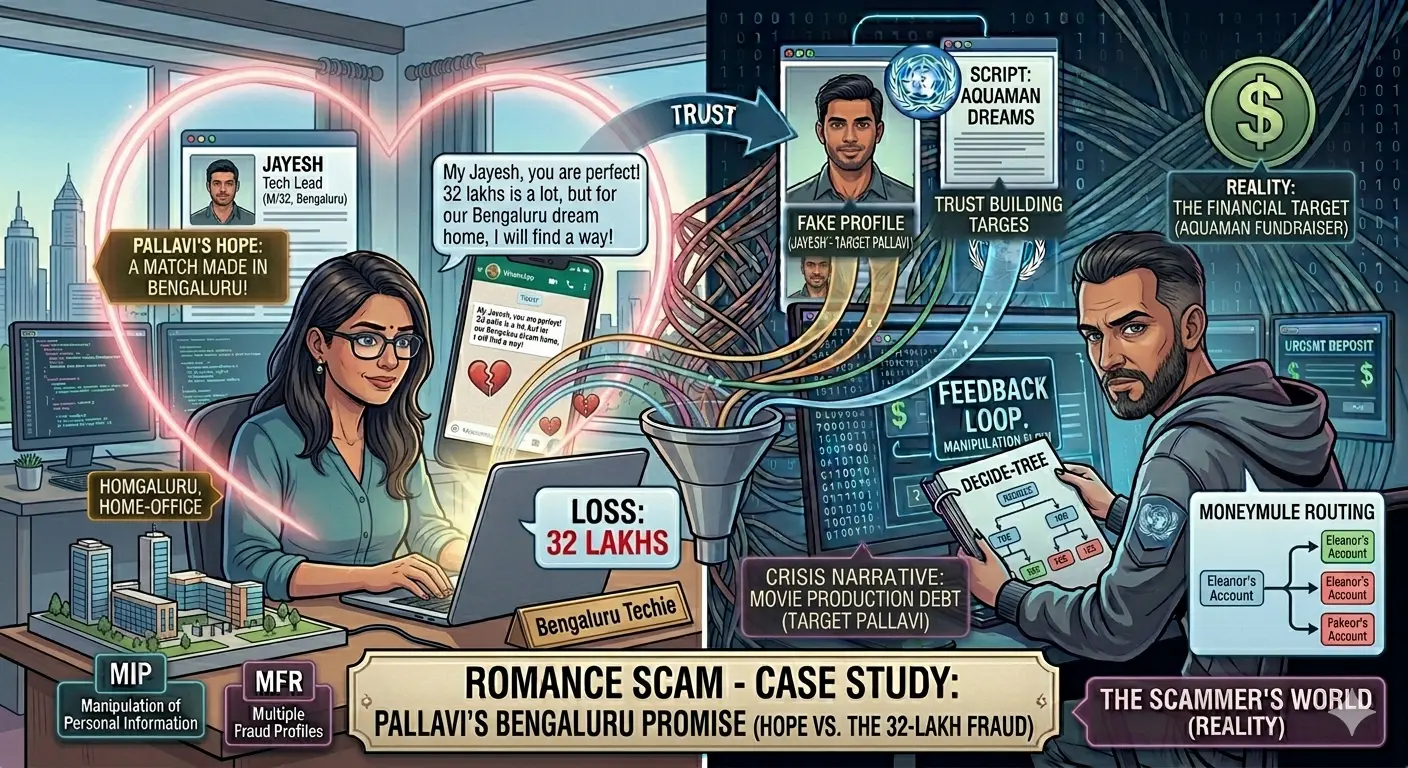
The Dream NRI Groom Who Vanished: A Bengaluru Techie’s ₹30 Lakh Nightmare
In September 2025, Pallavi, a 34-year-old software engineer from Bengaluru’s Banaswadi neighborhood, did what millions do—she uploaded her profile on a matrimonial website, hoping to find a life partner. What she found instead was a meticulously crafted trap that would drain her life savings of ₹30.2 lakh and shatter her trust in the promise of love .
The Perfect Stranger
A man named Jayesh reached out. His profile was impressive: an Anglo-Indian living in Canada, his family settled in the UK, employed by a highly reputed company. He called her from a Canadian number (+1(548) 901-2536) and expressed a sincere desire—he wanted to marry an Indian woman and settle permanently in India .
Their conversations grew frequent. Jayesh was patient, charming, and convincing. Within days, he spoke of visiting India to meet her family and finalize their marriage. Trusting him completely, Pallavi deleted her matrimonial profile—just as he suggested .
The Relocation Plan
Then came the next step. Jayesh announced he was relocating to India permanently and had already shipped his luggage ahead, along with special gifts for her. He said the parcel was being handled by a logistics firm called Inter Air Delivery Centre .
Days later, Pallavi began receiving calls from people posing as agents of this firm. Her parcel had arrived in India, they said. To release it, she needed to pay ₹37,000 as clearance charges. She transferred the amount .
The Escalating Demands
The agents then delivered more “news”: the consignment contained USD 1,00,000 in cash and a cheque worth USD 2,00,000. Now, additional charges were required—taxes, insurance, International Monetary Fund clearance, currency conversion fees. Between September 29 and October 28, Pallavi transferred money again and again, totaling ₹30.2 lakh to various bank accounts .
Each time she hesitated, she contacted Jayesh. He reassured her: “Pay it. The firm needs payment in Indian currency. I will return every rupee when I arrive in India” .
The Red Flag She Missed
Throughout their 20-day interaction, Jayesh had one consistent refusal—video calls. He shared photographs, spoke on voice calls, but never showed his face live. When Pallavi questioned the mounting payments, he dismissed her concerns .
Then the fraudsters demanded another ₹14.7 lakh. This time, something snapped. She confronted Jayesh. His profile vanished from the matrimonial site. The calls stopped .
The Aftermath
On October 28, Pallavi walked into the East Division Cyber Crime Police Station and filed a complaint. She brought evidence: chat transcripts, call logs, payment receipts, bank transaction details. Police registered a case under the Information Technology Act and BNS section 318 (cheating). Efforts began to trace and freeze the scam accounts .
A senior officer noted that such frauds are increasingly common—scammers exploit the emotional vulnerability of those seeking companionship, building elaborate trust before striking .
Lessons That Echo
Pallavi’s story offers brutal clarity. The scam worked because it followed a predictable blueprint: a fake NRI identity, swift declarations of commitment, elimination of the original platform, fabricated “gifts” to create obligation, a fake courier company, escalating fees, and absolute refusal of video verification .
The red flags were there. Video calls refused. Stories that grew grander with each payment. A suitor who asked for money before meeting. But love, or the hope of it, made them invisible.
Today, Pallavi’s name remains protected by police—she is a victim, not a cautionary tale. But her story is one of thousands unfolding across India’s matrimonial websites, where the dream of finding a life partner is weaponized by those who see only a bank balance .
The investigation continues. For Pallavi, the cost was not just financial—it was the realization that the man she trusted never existed.
Red Flags : How to Identify a Romance Scam
Recognizing romance scam red flags can protect you from emotional and financial devastation. Here are key warning signs:
Too Fast, Too Intense – Scammers declare love within days or weeks, using love bombing—constant flattery, grand promises, and future talk (marriage, travel) before meeting in person.
Avoids Meeting – They consistently cancel video calls or in-person meetings, citing emergencies, military deployment, or overseas work. Photos often appear professional or stolen—use reverse image search to verify.
Requests Money – The ultimate goal. They invent crises: medical emergencies, legal trouble, travel mishaps, or business “opportunities.” Requests start small, then escalate. They may ask for gift cards, cryptocurrency, or wire transfers—methods difficult to trace.
Isolation Tactics – They discourage you from discussing the relationship with family or friends, claiming others “don’t understand” your unique connection.
Inconsistent Details – Stories change. They may forget previous lies about their job, location, or background.
Excuses for Poor Communication – Bad camera, no video, living in remote areas, or working in sensitive industries (oil rig, military, doctor abroad) to explain lack of real-time interaction.
Moves Platforms Quickly – They push to leave dating apps for encrypted apps like WhatsApp or Telegram to avoid moderation and detection.
Profile Red Flags – Profile is new, has few photos, or features overly attractive, model-like images. Language may be generic or oddly phrased.
Trust your instincts. If something feels off—pressure, secrecy, or financial requests—stop communication immediately and report the profile. Legitimate love never requires secret payments or rescue missions.
Psychological Impact on Victims
The psychological impact of romance scams is profound and often exceeds financial losses. Victims experience a complex form of trauma akin to grief, as they mourn both the lost money and the betrayal of a relationship they believed was real.
Common effects include:
Deep Shame and Humiliation: Victims frequently blame themselves for being “fooled,” leading to secrecy, social withdrawal, and reluctance to report the crime. This self-stigma delays healing and justice.
Loss of Trust: Survivors struggle to trust others—future partners, friends, or even family members. The betrayal can shatter their ability to form new intimate relationships.
Prolonged Grief: They mourn the fabricated person they loved, a loss complicated by discovering that person never existed. This can trigger depression, anxiety, and post-traumatic stress.
Financial Trauma: Loss of life savings, retirement funds, or accumulated debt creates ongoing stress, housing instability, and feelings of worthlessness.
Suicidal Ideation: In severe cases, the combination of emotional devastation and financial ruin leads to suicidal thoughts. Studies show romance scam victims experience higher rates of suicidal ideation than other fraud victims.
Healing requires validation, not judgment. Support groups, therapy, and reporting the crime help victims rebuild self-worth and recognize they were manipulated by sophisticated criminals—not at fault.
Prevention and Reporting
Prevention:
Protecting yourself from romance scams begins with awareness. Never send money, gift cards, or cryptocurrency to anyone you haven’t met in person—regardless of the urgency or emotional story. Verify identities by conducting reverse image searches on profile photos. Be wary of love bombers who declare affection rapidly and avoid video calls. Keep conversations on dating apps rather than shifting to encrypted messaging platforms prematurely. Discuss new relationships with trusted friends or family; outside perspectives often reveal red flags you may overlook. Limit personal information shared online, as scammers weaponize details against you.
Reporting:
If you suspect a romance scam, stop all communication immediately. Report the profile to the platform where contact began. In the U.S., file a complaint with the FTC (ReportFraud.ftc.gov) and the FBI’s IC3 (ic3.gov). In India, report to the National Cyber Crime Reporting Portal (cybercrime.gov.in) or local cyber police. Save all evidence—messages, transaction details, screenshots—without embarrassment. Early reporting increases the chance of freezing funds and preventing further victims. Remember: reporting is an act of strength that disrupts criminal networks and protects others from similar trauma.